Ask a senior leader what they know about hiring in Africa and you will often get a confident answer built on experience in one or two markets. What works in Nairobi does not automatically work in Lagos. What is standard in Johannesburg bears little resemblance to what is required in Dakar or Casablanca. The organisations that treat Africa as a single talent market consistently pay the price: in compliance failures, in missed candidates, and in the reputational cost of being known as a company that does not understand the markets it operates in.
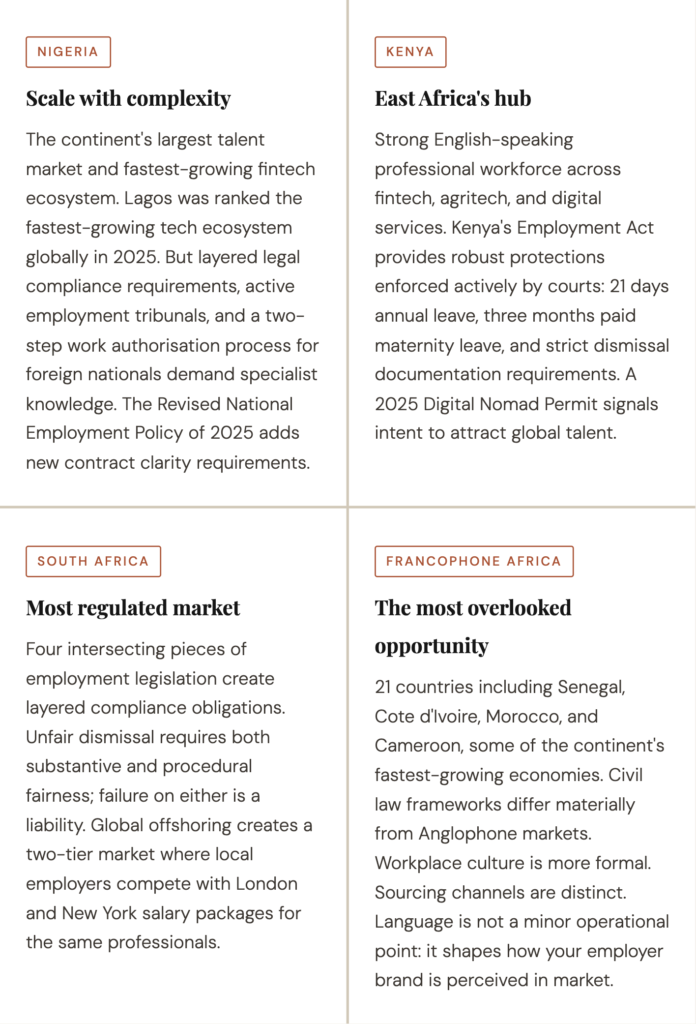
Five Markets, Five Different Realities
The Three Dimensions Where Organisations Get It Wrong
Legal compliance is the costliest error. A single contract template across multiple African markets is not a solution, it is a liability. Ghana requires a disciplinary hearing before termination for misconduct. Kenya enforces statutory benefits rigorously. Nigeria’s courts examine constitutional protections. Contractor misclassification is a growing enforcement target across the continent.
Sourcing channels differ by market in ways that generic job postings cannot bridge. In Nigeria, bootcamp communities and diaspora channels are important pipelines. In Francophone markets, institutional networks carry weight that English-language platforms simply cannot replicate. The best candidates in most African markets are reachable through relationships and targeted outreach, not a job board post.
Compensation and cultural expectations vary just as sharply. Decision timelines differ. The role of informal trust conversations before formal process differs. Candidate expectations around formality in communication differ. These are not obstacles: they are the the context in which great hiring happens, if you know to look for them.
“Failure to adhere to even one jurisdiction’s labour legislation can result in wasted resources, cost implications, and at worst, the collapse of entire cross-border transactions.”
LEXOLOGY, LABOUR LAWS IN AFRICA
The Talent Forge Africa Perspective
The organisations we work with that hire most effectively across Africa share one consistent trait: they are genuinely curious about the markets they operate in. They invest time in understanding not just what the law says but how the market works, what candidates care about, and where the best talent is actually found. They treat local expertise as a competitive asset rather than a compliance requirement.
At Talent Forge Africa, our work spans the full range of our six markets, from Anglophone to Francophone, from established hubs to emerging ecosystems. What we know from that experience is that the organisations that succeed are those that resist the temptation to simplify. Africa’s complexity is not a problem to be managed away. It is the terrain in which the right partners, with the right local knowledge, build decisive competitive advantage.
The question is not whether to hire across Africa. The question is whether you are doing it in a way that reflects the reality of the markets you are hiring in. The ones that do will access talent that their competitors cannot.
Our work spans Anglophone and Francophone markets, from established hubs to emerging ecosystems across our six markets. The organisations that hire most effectively across the continent share one trait: genuine curiosity about each market they operate in. Africa’s complexity is not a problem to manage away. It is the terrain in which the right partners build decisive competitive advantage.