In September 2025, Katlego Maphai stepped back as CEO of South Africa’s leading fintech Yoco after a decade at the helm. His reason was disarmingly honest: “The skills and energy needed to start and build a company are not always the same as those required to scale it.” He was not alone. Ghana’s mPharma, Egypt’s Elmenus, and Kenya’s Twiga Foods all saw founders hand over the chief executive role within the past two years.
This is not a story about failure. It is a story about maturity, and the hard-won wisdom to know the difference between leading a startup and running a company. Africa’s first wave of venture-backed businesses is entering its second decade, and the transition from founder-led to professionally managed is one of the defining talent conversations of the moment.
The Founder’s Paradox
The qualities that define great founders: conviction, speed, an almost irrational belief in the mission, are exactly what early-stage survival demands. But those same qualities can calcify into liabilities as organisations grow. When every significant decision still flows back to one person, scale creates pressure rather than leverage. Teams wait for answers. Talented people leave. Growth stalls at the ceiling of one individual’s bandwidth.
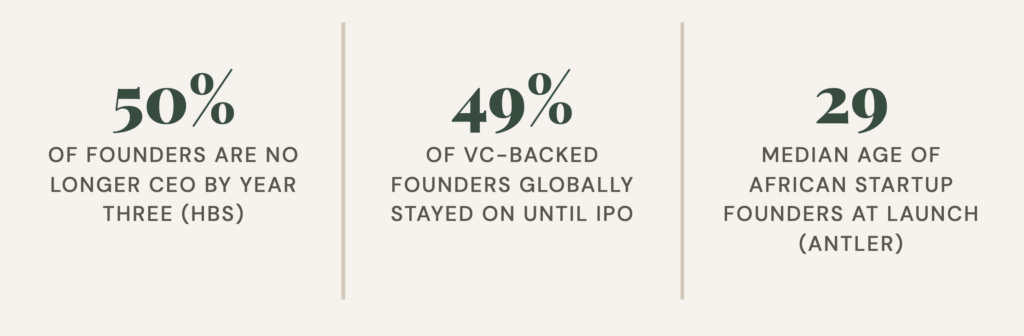
Research from Harvard Business School found that by the time ventures are three years old, half of founders are no longer the CEO. Globally, only 49 percent of VC-backed founders stay on until IPO. The data is consistent: building and scaling are different disciplines, and relatively few people are genuinely excellent at both.
What Africa’s Best Transitions Look Like
The most instructive recent African successions share a common thread: the founder made the call deliberately, before the business forced it. At Twiga Foods, founder Peter Njonjo’s exit led to a global search that brought in Charles Ballard, a seasoned Jumia Kenya executive. At Elmenus, founder Amir Allam was replaced by Walid El-Saadany, who had led Elmenus’s main competitor, Otlob, for five years. At Yoco, two remaining co-founders stepped up as co-CEOs, keeping institutional knowledge intact while shifting the operating model.
Three different playbooks, each chosen to suit the company’s specific next chapter. What they share is intentionality, and a board willing to have the conversation before a crisis forced it.
“This is what maturity looks like: less about the myth of the indispensable founder and more about building an enduring business.”
Launchbase Africa, September 2025
What Founders Owe Their Companies
The healthier model now emerging across the continent involves founders who redefine their contribution rather than abandoning it. The best outcomes see founders move into roles that leverage their unique assets: cultural stewardship, strategic vision, external relationships. They remain anchors of purpose while professional managers build the systems that deliver on it.
The transition from founder-as-CEO to professional CEO is not defeat. Handled well, with honest assessment and the right search process, it is one of the most important strategic decisions a growing African company can make. It is the decision that separates ventures from institutions.
The Talent Forge Africa Perspective
The The transition from founder-as-CEO to professional CEO is not a moment of defeat. It is, when handled well, one of the most important strategic decisions a growing African company can make. It is the decision that separates ventures from institutions. And it is the decision that the continent’s most exciting companies are increasingly getting right.
At Talent Forge Africa, we work with boards, founders, and investors navigating exactly this moment: defining what the next phase genuinely requires, building the criteria that reflect where the company is going rather than where it has been, and running searches that surface leaders built for that specific challenge. Getting this right does not happen by accident. The process matters as much as the outcome..
The best founders we work with are not those who hold on longest. They are those who make the call early enough to shape it, who stay involved in the ways that leverage their unique contribution, and who build something that outlasts any single leader, including themselves.
We work with boards, founders, and investors navigating exactly this decision: assessing what the next phase genuinely requires and identifying leaders built for it. Getting this right does not happen by accident. It requires honest criteria and a search process designed around where the company is going, not where it has been.