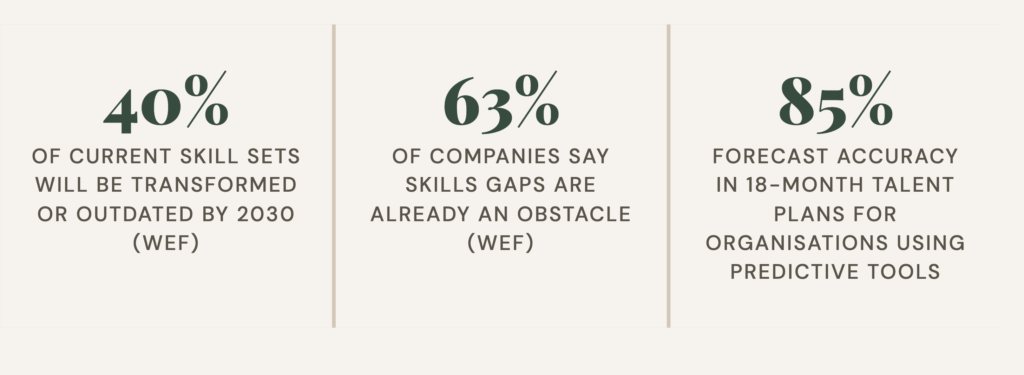
The World Economic Forum’s Future of Jobs 2025 report found that workers can expect two-fifths of their existing skill sets to be transformed or become outdated between now and 2030. Two-thirds of employers globally are already planning to hire specifically for AI skills. Forty percent anticipate reducing headcount where automation can substitute. These are not distant projections. They are shaping hiring decisions in Lagos, Nairobi, and Johannesburg right now, and most African organisations are navigating them without the data infrastructure to see clearly where they stand.
Talent intelligence is the shift from reactive to anticipatory. It connects three streams of information: what skills your organisation currently holds, what the external market can supply, and where the gap between your current capability and your future strategic needs will emerge. The organisations building this capability in Africa now are acquiring an advantage that will be very hard to replicate later.
Why Recruitment Alone Falls Short
Hiring for an open role, even well, addresses only the most immediate symptom of a talent challenge. It does not tell you which roles will become redundant in eighteen months. It does not surface the high-potential employee two assignments away from leadership readiness. It does not flag the skill your competitors are quietly stockpiling. And it does not tell you whether your three most critical people are already considering their next move.
| Dimension | Reactive Recruitment | Talent Intelligence |
|---|---|---|
| Trigger | A role opens; search begins | Strategic need anticipated; pipeline already in place |
| Time Horizon | Fill the current vacancy | Build for capability the organisation will need |
| Data Used | CVs, interviews, references | Skills mapping, market data, predictive analytics |
| Scope | External candidates for open roles | Internal mobility, development, succession, and external hiring together |
| Who Owns It | Recruitment Function | HR strategy, leadership, and the business together |
Why the Stakes Are Higher in Africa
Africa’s recruitment market is projected to reach $32 billion by 2031, growing at 8.7 percent annually. That growth is generating demand faster than traditional pipelines can supply it. The skills commanding the highest premiums: AI literacy, multi-jurisdictional compliance, digital product expertise. These are scarce across multiple markets simultaneously. Organisations that wait for the open role to create urgency will consistently find themselves behind those that have been building the pipeline for months.
Internal mobility is also chronically underused. In tight talent markets, the ability to see and develop capability inside your own organisation is the most cost-effective strategy available. But you cannot mobilise talent you cannot see. Without skills mapping and structured succession frameworks, internal talent remains invisible until it resigns.
“As workforce risks shift more quickly, organisations are placing greater emphasis on talent intelligence to strengthen resilience and anticipate risk before it becomes a gap.”
Mercer Global Talent Trends 2026
The Talent Forge Africa Perspective
The recruitment market in Africa is changing in ways that make the old model increasingly costly. Talent is scarcer in the roles that matter most, skills are evolving faster than annual hiring cycles can track, and organisations that treat every vacancy as a fresh search from scratch are paying a premium for a process that should not need to start from zero.
At Talent Forge Africa, we are seeing more client conversations shift from “help us fill this role” to “help us understand our talent landscape and build the capability we will need.” That shift reflects a growing recognition that the organisations with the strongest competitive positions over the next decade will be those that have built genuine intelligence about their own people and their markets, and that use it to make decisions the field does not see coming.
Talent intelligence is not a technology project or an HR initiative. It is a leadership commitment to treating people strategy with the rigour and foresight that every other dimension of business strategy receives. The organisations that make that commitment in Africa today will find themselves, in three to five years, operating with a talent advantage that is very hard for competitors to replicate in a hurry.
We are seeing more client conversations shift from “help us fill this role” to “help us understand our talent landscape.” That shift is the right one. Talent intelligence is not a technology project: it is a leadership commitment to treating people strategy with the same rigour applied to every other dimension of business strategy. The organisations that make that commitment today will be operating with an advantage in three to five years that competitors will struggle to close quickly.