Approximately 40 percent of African diaspora members are currently considering a return home. Africa’s diaspora sends close to $100 billion in annual remittances back to the continent, more than official development assistance in most countries. Ghana recorded a historic $7.8 billion in 2025. Nigeria received close to $25 billion in 2024. This is not a community that turned its back on home. It is a community that never fully left, and a significant portion of it is ready to come back.
Why They Are Returning
The opportunity gap has narrowed. Lagos was ranked the fastest-growing tech ecosystem globally in 2025. Rwanda’s $2 billion Kigali Innovation City is drawing entrepreneurs from across the world. Accra, Nairobi, and Abidjan are producing competitive startup ecosystems with genuine regional reach. The Africa that diaspora professionals left is not the Africa they are returning to.
Remote work removed the career sacrifice that once made return so costly. A professional who spent a decade at a European firm can now return to Lagos while retaining their international role, salary, and trajectory. The return no longer requires choosing between home and career, and that structural change is accelerating movement home more effectively than any government incentive programme has managed.
Purpose is doing the rest of the work. Research consistently shows that African diaspora professionals are 65 percent more likely to join an organisation offering purpose, accelerated impact, and a clear development path. Many returning professionals are also responding to something that Western corporate environments rarely offer at mid-career: genuine leadership authority, early and substantive, without a decade-long queue.
“African professionals are 65% more likely to join an organisation offering purpose, accelerated impact and development pathways.”
Global Career Company, Employer of Choice Research, 2025
What Employers Get Wrong
The failure modes are consistent. Employers undervalue international experience, treating years abroad as less relevant than local tenure. They offer roles without genuine leadership runway, losing candidates who returned specifically for the early authority that abroad was not offering. They skip structured reintegration support, leaving returnees to navigate unfamiliar cultural and operational context alone. And they lead with base salary benchmarked only against local rates, without modelling the full picture of what makes a return genuinely competitive.
Diaspora talent arrived with a deliberate choice. They chose to come back. Employers who treat them like any other candidate miss what makes this group distinctive, and they lose them to organisations that do not.
The Talent Forge Africa Perspective
The returning diaspora is not a niche talent segment that thoughtful employers might consider exploring. It is rapidly becoming a primary pipeline for senior and specialist roles across the continent’s most competitive sectors: fintech, health technology, professional services, agribusiness, and executive leadership.
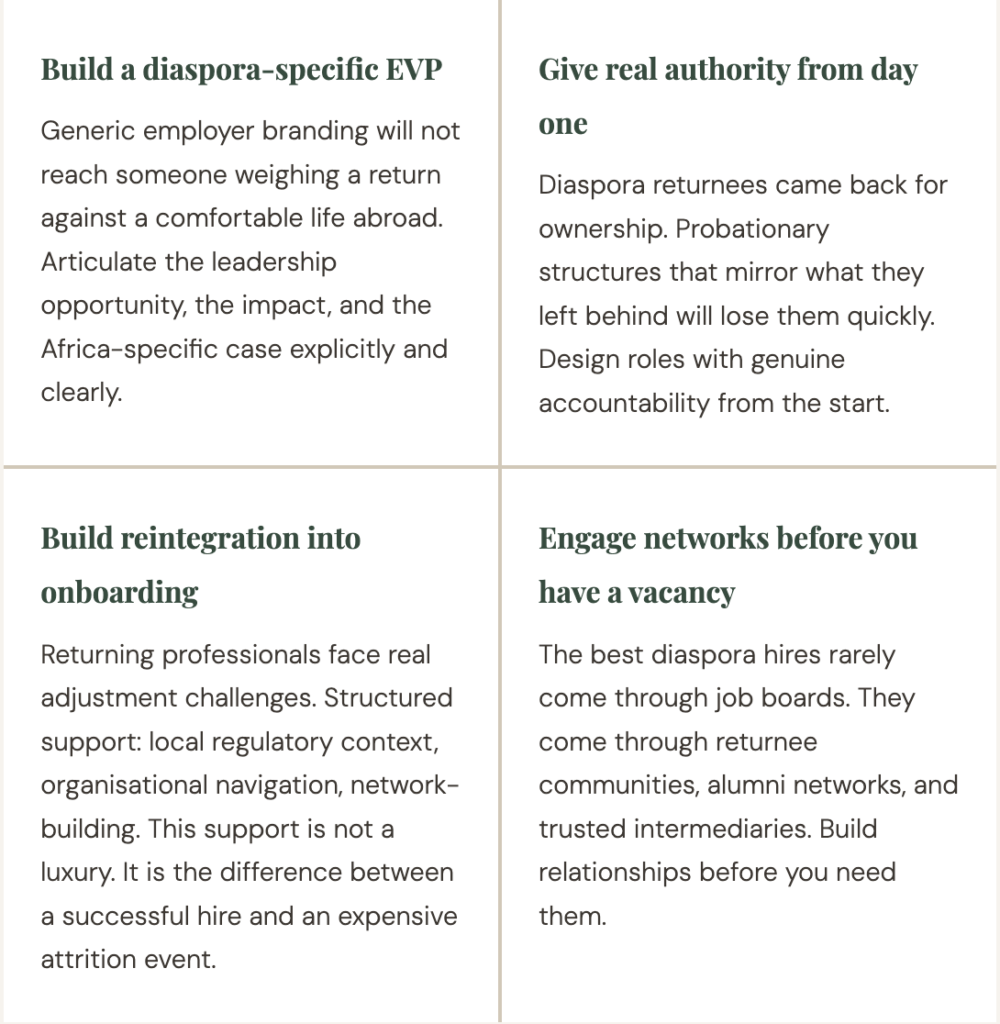
At Talent Forge Africa, we work with organisations at every stage of building their diaspora talent strategy, from defining the proposition to structuring the hiring process and supporting the reintegration that determines whether a promising hire becomes a lasting contributor. The organisations we see doing this best treat diaspora engagement not as a one-off recruitment drive but as a permanent strategic pillar, as deliberate and well-resourced as any other talent acquisition channel.
The diaspora is coming home. The organisations that are ready for them, that have built the proposition, the culture, and the structures to receive them well, will find themselves with a talent advantage that compounds over time. Those that are not ready will find themselves competing for the same locally available pool as everyone else, while the most globally experienced African professionals choose employers who took the time to understand what makes a return worth making.
Diaspora engagement is one of the most active areas of our talent strategy work. The organisations doing this well treat it as a permanent strategic pillar, not a one-off recruitment drive. The diaspora is coming home. The organisations ready to receive them will build a talent advantage that compounds for years.