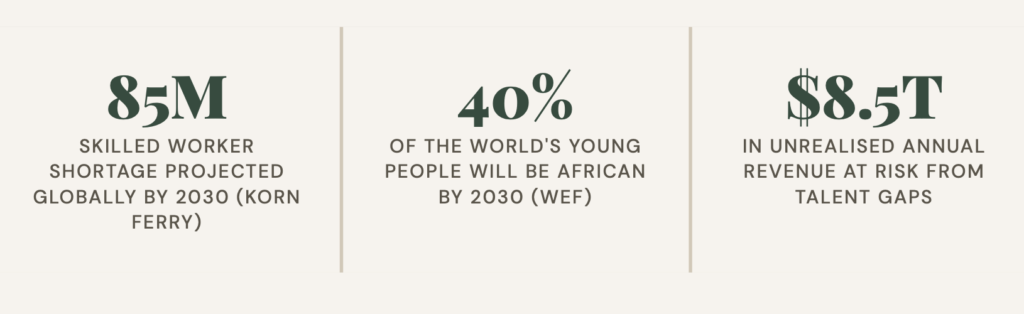
Korn Ferry projects that by 2030, the world will face a shortage of more than 85 million skilled workers, representing $8.5 trillion in unrealised annual revenue. That gap cannot be filled from within the developed world’s existing labour base. Africa, with the fastest-growing working-age population on earth, is where a meaningful part of the answer lies, and investors are are beginning to act on that understanding.
Why They Are Returning
This is not sentiment. It is arithmetic. By 2030, 40 percent of the world’s young people will be African. The continent already has over 700,000 professional software developers. In 2025, Lagos was ranked the fastest-growing tech ecosystem globally, ahead of Istanbul and Mumbai. African-built fintech, logistics, and health technology products have competed at a global standard long enough to shift the burden of proof on talent quality. Investors are not taking a chance on Africa. They are responding to evidence.
Four Reasons the Conversion Has Changed
The failure modes are consistent. Employers undervalue international experience, treating years abroad as less relevant than local tenure. They offer roles without genuine leadership runway, losing candidates who returned specifically for the early authority that abroad was not offering. They skip structured reintegration support, leaving returnees to navigate unfamiliar cultural and operational context alone. And they lead with base salary benchmarked only against local rates, without modelling the full picture of what makes a return genuinely competitive.
Remote work normalisation is the most structural driver. Organisations no longer need to relocate talent to access it. Approximately 38 percent of surveyed African developers already work for international companies. The infrastructure for global talent access now exists at scale and the shift is permanent.
The economics remain compelling. A software developer in Nigeria or Kenya may cost 30 to 50 percent less than a counterpart in the US or Western Europe, at genuinely competitive quality. For global firms where the EU alone faces a projected shortfall of 8 million ICT specialists by 2030, this is not a cost play. It is a capacity play.
When Moniepoint raised $100 million in 2025 with Visa among its investors, it validated not just the product but the engineering talent that built it. The same is true of Flutterwave, Wave, and OPay. Quality has been demonstrated at scale. Investors no longer need to take it on faith.
Finally, and most important for long-term investors, Africa is the world’s last major demographic growth market. As Europe, East Asia, and parts of Latin America age, Africa’s labour force continues to grow. The Brookings Institution projects 650 million digital training opportunities on the continent by 2030, representing $130 billion in economic value and 230 million potential digital jobs. The advantage compounds over decades.
“Africa is increasingly powering the global economy from within. From mobile money to cloud computing, innovations born on the continent are being gifted to the world.”
Zekarias Amsalu, Managing Director, AFTS, January 2026
What This Means For African Businesses
Global attention on African talent creates urgency alongside opportunity. As international firms compete for the same engineers and financial professionals, salary expectations are rising and retention is hardening as a challenge. African companies that do not respond with competitive compensation, real development pathways, and purposeful work will lose their best people to the global market. That process is already underway in Lagos, Nairobi, and Cape Town.
The organisations that will benefit most are those that move with deliberate strategy rather than reactive urgency: building the talent infrastructure that makes them competitive not just locally but against any employer their people might consider.
The Talent Forge Africa Perspective
The global investor interest in African talent is not a passing trend driven by enthusiasm for emerging markets. It is a structural realignment driven by demographic arithmetic that cannot be reversed and a skills shortage that cannot be solved from within the developed world’s existing labour base.
At Talent Forge Africa, we work with organisations at both ends of this dynamic: African companies building talent strategies that can compete with global firms, and international investors and employers building structured access to Africa’s professional talent base. The questions we are hearing are becoming sharper, not just “is there talent in Africa?” but “how do we build reliable access to it, retain it, develop it, and deploy it effectively across borders and functions?”
Those are the right questions. The organisations that answer them well, with genuine investment in the people they are developing and the markets they operate in, will find themselves at the front of one of the most significant talent stories of the next generation.
We work with African companies building talent strategies that can compete with global firms, and with international investors building structured access to Africa’s professional talent base. The window to build a proactive position in Africa’s talent market is open. It will not stay open indefinitely.