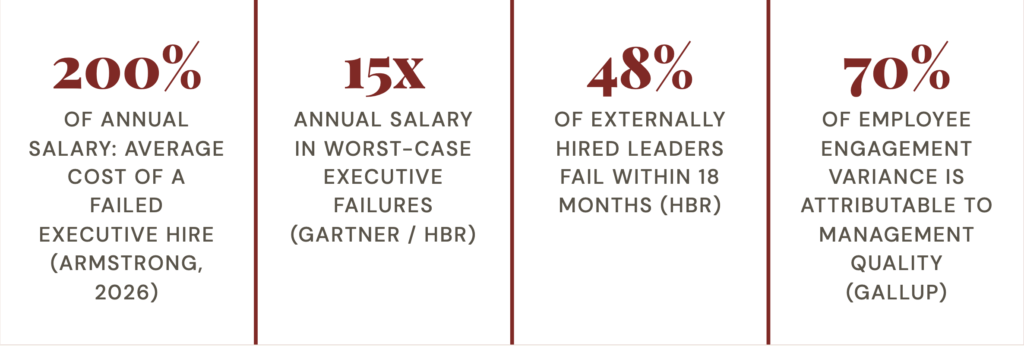
Nearly half of externally hired leaders fail within 18 months. A failed executive hire can exceed 200 percent of annual salary once all costs are properly counted. A single poor leader costs an organisation an average of $126,000 per year in lost productivity and team disengagement. These figures are uncomfortable in any market. In Africa’s growth contexts. In these markets, talent pools are smaller, professional networks are tighter, and the pace of expansion leaves less margin to absorb disruption, the same failure compounds faster and recovers slower.
The Full Cost Stack
The direct financial cost is what organisations typically calculate: search fees, salary paid during a failed tenure, severance, and the cost of a second search. For a senior role at $150,000 base, that exposure runs between $200,000 and $300,000 at the conservative end of the research range.
The strategic cost is larger and harder to quantify. A misaligned leader does not just underperform in isolation. They slow the organisation around them. Projects stall. Decisions are deferred. Strategic initiatives require expensive correction. McKinsey research found that top-performing leaders produce five times more shareholder value than average ones over five years. Applied in reverse, that multiplier captures what the wrong person costs in foregone opportunity across the full period of their tenure.
The talent cost is the most consistently underestimated. Gallup research shows that 70 percent of the variance in employee engagement is attributable to direct management quality. In Africa’s 2025 talent research, 24 percent of employees cited poor leadership as the direct reason for their last resignation. A failed senior hire will typically trigger two to three high-performer departures within six months, each costing 150 to 200 percent of salary to replace. That is not one expensive mistake. It is a cascade.
Why Africa’s Growth Markets Amplify Every Layer
Smaller talent pools mean fewer second chances
In Nigeria’s fintech sector, 70 percent of tech startups cite recruitment as their primary bottleneck. A search that produces the wrong outcome does not simply cost money: it can set an organisation back six to twelve months in a market where execution speed is the primary competitive differentiator. The word also gets out in ways it would not in larger, more diffuse markets.
Network fit matters more than cultural fit in relationship-driven markets
Harvard Business Review research found that external leaders most commonly fail not because of skill gaps but because of an inability to integrate with the people around them. Hiring specifically for network fit improves two-year leadership performance by 30 percent, and this has more than twice the impact of assessing for cultural fit alone. In Africa’s relationship-driven business environments, this dynamic is even more pronounced than the global research suggests.
Reputation travels at speed in tight professional networks
The Jack Hammer Africa Workplace Trends Report 2026 puts it plainly: in Africa’s professional communities, your reputation travels fast, and every candidate interaction shapes your employer brand across an entire industry. Repeated visible leadership changes signal instability and make every subsequent search harder and more expensive to run.
“A misaligned leader does not just miss targets. They shift the organisation’s direction. By the time the mistake is recognised, the damage is often already significant.”
Avant Executive Search, November 2025
What Founders Owe Their Companies
The healthier model now emerging across the continent involves founders who redefine their contribution rather than abandoning it. The best outcomes see founders move into roles that leverage their unique assets: cultural stewardship, strategic vision, external relationships. They remain anchors of purpose while professional managers build the systems that deliver on it.
The transition from founder-as-CEO to professional CEO is not defeat. Handled well, with honest assessment and the right search process, it is one of the most important strategic decisions a growing African company can make. It is the decision that separates ventures from institutions.
The Talent Forge Africa Perspective
At Talent Forge Africa, we have worked with enough organisations that have experienced the full cost of a leadership hiring failure to know what it does. It is not just expensive in the ways the research describes. It is demoralising for the teams that lived through it, disruptive for the investors who backed the business, and damaging to the confidence of the board in its own judgement. Recovery takes longer than the initial mistake.
The research is equally clear on the upside: the right leader, placed correctly, creates compounding returns. Top-performing leaders produce five times more shareholder value over five years than average ones. In Africa’s growth markets, where the opportunity landscape is expanding rapidly and the right leadership can genuinely shape how much of it an organisation captures, the value of getting this right is not merely the avoided cost of getting it wrong. It is the full strategic upside of a market that rewards decisive, well-led organisations.
The investment required to run a rigorous, properly resourced leadership search with deep local market knowledge is real. It is also, in every case we have seen, a fraction of the cost of the alternative.
The research on leadership hiring failure is consistent on one finding above all others: most failed executive hires are preventable. They result from processes that prioritised speed over rigour, credential over fit, or that did not invest adequately in understanding what the role truly required before the search began. The investment required to run a rigorous, market-informed leadership search is real. In every case we have seen, it is a fraction of the cost of the alternative.